What Does a Holiday Home Management Company in Dubai Actually Do?
Most owners ask us the same question in the first meeting, usually phrased politely: what exactly am I paying for?
It is a fair question. From the outside, holiday home management looks like listing a property and collecting money. The apartment exists whether or not we are involved. The guest books through Airbnb or Booking.com either way. What is left?
The honest answer is that almost everything we do is invisible by design, and that is the point.
Convenience is not the removal of complexity. It is the relocation of complexity.
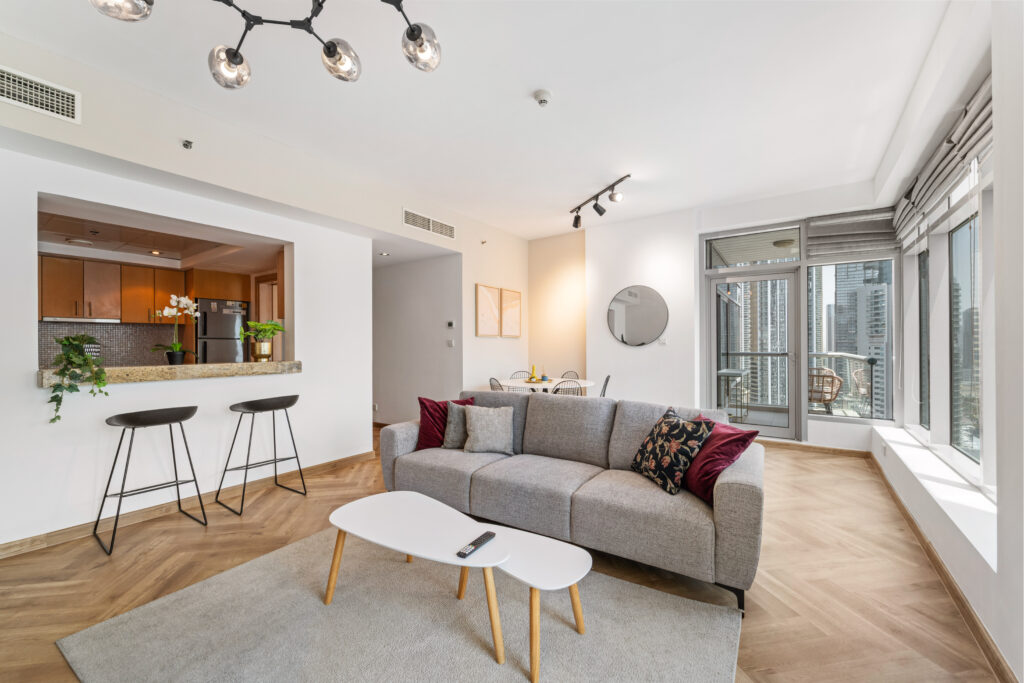
A guest arrives at a Dubai holiday home. The door opens. The apartment is spotless. The instructions arrived before they were needed. The air conditioning works. Nothing requires a phone call.
What the guest experiences is simplicity.
What produced it is not simple at all. Someone coordinated the housekeeping. Someone inspected the property afterwards and photographed it. Someone caught a failing AC unit before it became a midnight complaint. Someone set the rate three months earlier. Someone was awake and reachable when the lift broke.
The complexity did not disappear. It moved — off the guest, off the owner, and into our operation.
That is what you are actually paying for.
What happens between one guest leaving and the next arriving
This is the part owners rarely see, so it is worth setting out plainly.
Check-out. The booking closes and a turnover task is generated automatically, assigned to the cleaning partner for that building.
Housekeeping. The team cleans to a fixed standard, not a general impression of tidiness. Linen, consumables, presentation.
Inspection. An inspector attends and works through a thirteen-point checklist covering the condition of the property, anything damaged, anything missing, anything that will fail soon. Photographed and logged.
Maintenance. Anything found gets raised as a job before the next guest arrives, not after they complain. A slow drain today is a flooded bathroom in three weeks.
Rate and listing. Pricing is reviewed against demand, events and the season. Listings stay synchronised across every channel so the same night is never sold twice.
Guest communication. Access details, arrival instructions, questions at odd hours, problems at odder ones.
Repeat that across a portfolio, every day, without letting a single unit slip. That is the job.
Why the small things carry the most weight
Nobody writes a review praising the maintenance that prevented a problem they never knew existed. Nobody gives five stars because the housekeeping schedule was well sequenced.
What guests actually notice is narrower than the industry likes to admit: a door that opens when it should, a property exactly as clean as the photographs promised, towels where they are supposed to be, and a response before an irritation becomes a complaint.
None of that sounds revolutionary. Together it produces the only thing that matters commercially — a guest who leaves satisfied and says so in public.
In August, every review we received across the portfolio was five stars. Not most of them. Every one.
That did not come from software. It came from months of training our on-site team to check the details a guest notices without being able to name them.
Technology should remove friction, not relocate it onto the guest
There is a common argument that automation makes hospitality colder. There is something in it, but only half.
Technology earns its place when it removes people from tasks that never needed human warmth. Access codes that arrive without anyone answering a phone. Smart locks that mean no key handovers. Monitoring that flags a problem before it becomes damage. An owner portal that shows performance without anyone having to request a statement.
None of that replaces hospitality. It creates room for it.
The failure mode is the opposite: a digital check-in requiring three apps, a password reset, an identity verification and a call to support. That is not convenience because the receptionist is gone. It is bureaucracy in a digital costume, and guests notice.
The test is simple. Does the technology make the guest’s world lighter, or does it hand them a new task?
What this means if you own a property in Dubai
We manage holiday homes across Palm Jumeirah, Downtown, Dubai Marina, JBR, Bluewaters, City Walk and Al Wasl.
We are DTCM licensed. We carry comprehensive public liability insurance across the portfolio — many operators in this market do not. Owners have portal access to their own occupancy, bookings and payouts, at any time, without asking us for anything.
We have been in Dubai’s short-term rental market for close to a decade. At our peak we operated close to 200 homes, and we did it without external funding or investors behind us. Every system we run was built because we needed it, not because a board asked for it.
If you own a property in one of these communities and you are weighing whether to manage it yourself or hand it over, we will give you an honest assessment of what it should earn and what it will take to run.
Request a property assessment →
Related reading: Yield Is Not the Endgame: Why Your Entry Price and Your Holding Period Decide Your Returns.